
Reinforcement increases the quality of rubber goods
To achieve the desired reinforcement of a silica-filled rubber a chemical link between the silica and the polymer matrix is needed. Here, so-called bi-functional silanes are used to provide a covalent bond between silica and rubber.

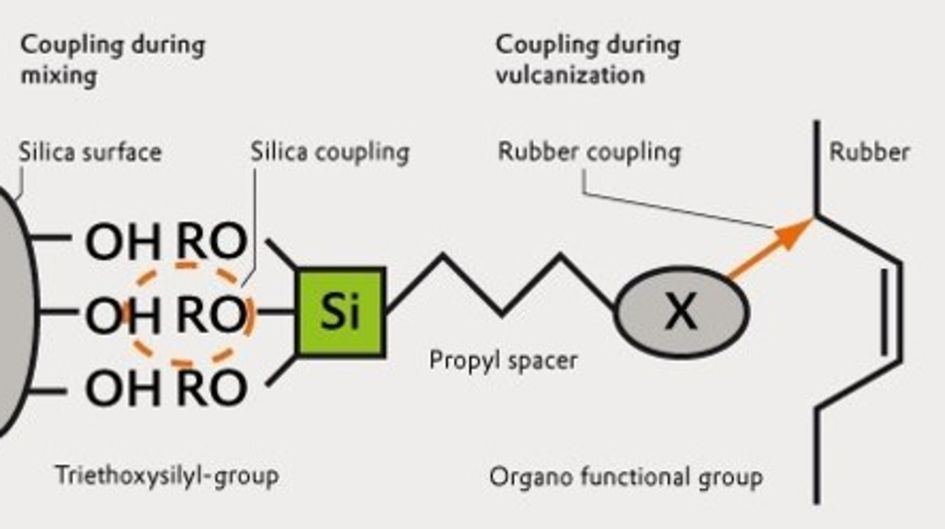
The principle of this “chemical reinforcement” by a bi-functional silane as coupling agent is displayed in the figure below. As seen in the figure, the coupling agent, the rubber silane, consists of three parts: a silica-active site, a hydrocarbon spacer and a rubber-active site. The silica-active site, preferably a triethoxysilyl group, provides the coupling of the silane to the silica surface during the mixing process under release of alcohol.
The spacer, most often a propyl group, links the silica- and the rubber-active site. The rubber-active site reacts with the polymer during vulcanization and therefore couples the silica chemically to the rubber. This “chemical reinforcement” provides the basis for the unique property profile of the Silica/Silane filler system.